
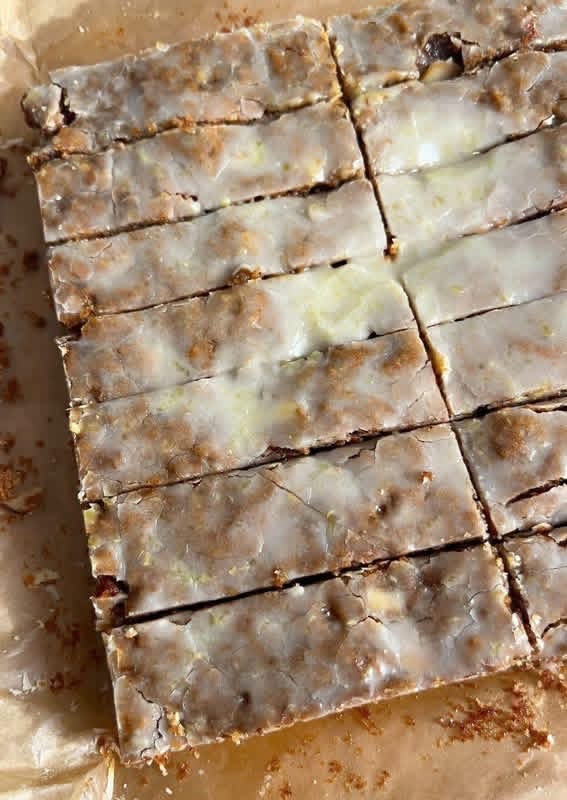
Why Make These Bars? These are the cozy, spiced German holiday treats that taste like Christmas in every bite. Lebkuchen is a traditional German gingerbread—softer and more aromatic than its American cousin—with warm honey, cinnamon, cloves, and a bright hint of citrus. These bar cookies are much easier than rolling and icing individual cookies, but they deliver all the old-world flavor. The bars are soft, chewy, and topped with a simple citrus glaze that cracks beautifully as they cool. They improve with age, stay moist for weeks, and make the perfect addition to a holiday cookie tin or a gift for someone special.
Ingredients
For the bars: two and a half cups all-purpose flour, two teaspoons ground cinnamon, one teaspoon ground ginger, half teaspoon ground cloves, half teaspoon ground allspice, half teaspoon salt, one teaspoon baking powder, half cup unsalted butter (softened), three quarters cup packed dark brown sugar, half cup molasses (not blackstrap), two large eggs (room temperature), zest of one orange (about one tablespoon), half cup candied orange peel (finely chopped), and one cup chopped almonds or walnuts.
For the glaze (optional but traditional): one and a half cups powdered sugar (sifted) and two to three tablespoons fresh lemon juice or milk. Optional: lemon zest for brightness, or substitute orange juice for the lemon juice.
Equipment Needed
A 9×13 inch baking pan, parchment paper, a large mixing bowl, a medium mixing bowl, an electric mixer (hand or stand), a whisk, a rubber spatula, a small bowl for the glaze, and a wire cooling rack.
Method
Preheat your oven to 175°C (350°F). Grease a 9×13 inch baking pan and line it with parchment paper, leaving some overhang on two sides for easy removal.
In a medium bowl, whisk together the flour, cinnamon, ginger, cloves, allspice, salt, and baking powder until well combined. Set aside.
In a large bowl, beat the softened butter and brown sugar together with an electric mixer on medium speed until light and fluffy, about two to three minutes. Scrape down the sides of the bowl.
Add the molasses, eggs, and orange zest. Beat on medium speed until smooth and well combined, about one minute. The mixture may look slightly curdled—that is fine.
Gradually add the dry ingredients to the wet ingredients, mixing on low speed just until combined. Do not overmix. The dough will be thick and sticky.
Fold in the chopped candied orange peel and chopped nuts with a rubber spatula until evenly distributed.
Spread the batter evenly into the prepared baking pan. Use a spatula or lightly moistened fingers to press it into an even layer—the dough is sticky, so moistening your fingers helps.
Bake for twenty five to thirty minutes, until the edges are firm and a toothpick inserted into the center comes out clean or with just a few moist crumbs. The center should still be soft but not wet.
Let the bars cool completely in the pan on a wire rack. Do not glaze while warm unless you want the glaze to soak in (traditional for some versions). For a crackled top glaze, apply while warm; for a thicker, more opaque glaze, wait until cool.
Make the glaze. In a small bowl, whisk together the sifted powdered sugar and lemon juice (or milk) until smooth. Add more liquid one teaspoon at a time if needed—the glaze should be thick but pourable, like heavy cream. Stir in lemon zest if desired.
Drizzle or spread the glaze evenly over the cooled bars. Let the glaze set for fifteen to twenty minutes before slicing.
Use the parchment overhang to lift the slab from the pan. Cut into sixteen to twenty bars or squares.
Storage
Store in an airtight container at room temperature for up to two weeks. Lebkuchen actually improves with age—the flavors deepen and the texture becomes perfectly chewy after one to two days. For the best flavor, let the bars rest for at least twenty four hours before serving. Do not refrigerate, as this can dry them out. Freeze unglazed bars for up to two months. Thaw at room temperature, then glaze before serving. To freeze, wrap the slab tightly in plastic wrap, then in foil.
Variations
For a honey-based version, replace the molasses with honey and reduce the brown sugar to half a cup. For a chocolate glaze version, melt half a cup of semi-sweet chocolate chips with one tablespoon of butter and spread over the cooled bars. For an almond version, use finely ground almonds instead of chopped almonds for a denser, more traditional texture. For a nut-free version, omit the nuts or replace them with sunflower seeds or additional candied peel. For a gluten-free version, substitute a cup-for-cup gluten-free flour blend and ensure your baking powder is gluten-free. For a spicier version, add half a teaspoon of ground cardamom and a pinch of black pepper to the spice blend. For a raisin version, substitute golden raisins for the candied orange peel (soak them in warm orange juice for ten minutes first). For a lebkuchengewürz version, use two tablespoons of pre-mixed German Lebkuchen spice blend instead of the individual spices.
Serving Suggestions
Serve alongside coffee, tea, or mulled wine for a classic German Christmas experience. Arrange on a holiday cookie platter with pfeffernüsse, springerle, and other traditional Christmas cookies. Package in decorative tins or cellophane bags tied with ribbon for homemade gifts. Dust with powdered sugar before serving instead of glazing for a simpler presentation. Serve with a dollop of whipped cream or vanilla ice cream as an easy dessert.
Tips for Best Results
Do not use blackstrap molasses. Blackstrap is too bitter and dark for Lebkuchen. Use light or dark baking molasses (like Grandma’s or Brer Rabbit). For an even milder flavor, substitute honey for half of the molasses.
Use candied orange peel for authentic flavor. Traditional Lebkuchen gets its signature citrus note from candied peel. Find it in the baking aisle near chocolate chips and dried fruit. If you cannot find it, substitute golden raisins soaked in orange juice with one tablespoon of orange zest.
Let the bars rest before serving. Lebkuchen is not meant to be eaten fresh from the oven. The flavors need time to meld and mellow. Wrap the glazed bars tightly and let them sit at room temperature for one to two days. They will transform from good to spectacular.
Do not overbake. The bars should be soft and slightly underdone in the center when you take them out of the oven. They will continue to set as they cool. Overbaked Lebkuchen becomes dry and crumbly instead of chewy. Check at twenty five minutes.
Press the dough evenly into the pan. The dough is thick and sticky. Use a spatula or your fingers (lightly moistened with water) to press it into an even layer. Uneven thickness leads to uneven baking—thin edges may burn while the thick center stays underdone.
Use fresh, good quality spices. Lebkuchen relies entirely on its spice blend for flavor. Old, stale spices from the back of your cupboard will result in a flat, dull taste. Buy fresh cinnamon, cloves, and ginger for the best results.
Add orange zest for brightness. The combination of orange zest in the dough and orange or lemon juice in the glaze brightens the deep, dark spices and honey. Do not skip this—it is what makes Lebkuchen distinct from plain gingerbread.
Glaze while warm for a thin, crackled finish. Traditional Lebkuchen is glazed while still slightly warm so the glaze soaks into the surface and forms a thin, crackled crust. If you prefer a thicker, more opaque icing, let the bars cool completely before glazing.
Make a double batch. Lebkuchen bars keep for weeks and make wonderful gifts. They also freeze beautifully. Make two batches at once and save one for later in the holiday season.
Cut with a sharp knife, wiping the blade clean between cuts. The glaze can be sticky, and the bars are soft. A clean, sharp knife gives you neat, bakery-style squares. For the cleanest cuts, refrigerate the slab for thirty minutes before slicing.