
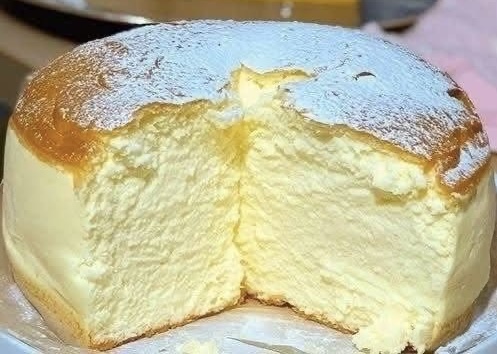
Why Make This Cake? This is the lightest, fluffiest, most ethereal cake you will ever bake. Cloud cake—also known as angel food cake from scratch—lives up to its name with a pillowy soft crumb, a delicate vanilla sweetness, and a cloud-like texture that melts in your mouth. It contains no butter, no egg yolks, and no oil, yet it is impossibly moist and tender. Perfect for summer desserts, birthday parties, or any time you want a guilt-free slice of heaven. Top it with fresh berries and whipped cream, or enjoy it completely plain.
Ingredients
For the cake: one and a quarter cups egg whites (from about ten large eggs), at room temperature, one and a quarter teaspoons cream of tartar, one teaspoon vanilla extract, one cup granulated sugar (divided into three quarters cup and one quarter cup), one cup cake flour (not all-purpose), and one quarter teaspoon salt.
For serving (optional): fresh berries (strawberries, raspberries, blueberries), lightly sweetened whipped cream, or a dusting of powdered sugar.
Equipment Needed
A ten-inch tube pan (angel food cake pan) with a removable bottom. Do not use a non-stick pan—the batter needs to climb up the sides. A stand mixer or electric hand mixer, a fine-mesh sieve, a rubber spatula, a sifter or flour sifter, a small bowl, a wire cooling rack, and a long narrow spatula or knife for loosening the cake.
Method
Preheat your oven to 175°C (350°F). Have your tube pan ready—do not grease it. The batter must cling to the ungreased sides to rise properly.
Separate the eggs while they are cold. Cold eggs separate more cleanly. Place the whites in a large, impeccably clean mixing bowl. Save the yolks for another use (custard, creme brulee, or scrambled eggs). Let the egg whites come to room temperature for thirty minutes before whipping—room temperature whites whip to greater volume.
Sift the cake flour and one quarter cup of the granulated sugar together into a small bowl. Sift twice to incorporate air and ensure a light texture. Set aside.
In the large bowl, beat the egg whites on medium speed until foamy, about one minute. Add the cream of tartar and salt. Continue beating until soft peaks form—the whites should hold their shape but the peaks should flop over when you lift the beaters.
Gradually add the remaining three quarters cup of granulated sugar, two tablespoons at a time, while beating on medium-high speed. Add the vanilla extract along with the last addition of sugar. Continue beating until stiff, glossy peaks form. The meringue should be smooth and bright white, and when you lift the beaters, the peaks should stand straight up without drooping. Do not overbeat or the meringue will become dry and grainy.
Sift about one quarter of the flour-sugar mixture over the meringue. Gently fold it in with a rubber spatula using a cutting motion down through the center, across the bottom, and up the side. Rotate the bowl a quarter turn and repeat. Do not stir—folding keeps the air in the meringue. Repeat with the remaining flour mixture, adding it in three or four batches, until just combined. The batter will be thick and airy.
Gently spoon the batter into the ungreased tube pan. Run a knife or spatula through the batter to remove any large air pockets. Smooth the top with the spatula.
Bake for thirty five to forty minutes, until the cake is golden brown, springs back when lightly touched, and a wooden skewer inserted into the center comes out clean. The top will have deep cracks—this is normal and expected for angel food cake.
Immediately invert the pan onto a bottle or a cooling rack with legs. If your tube pan has feet, it will stand upside down on its own. If not, place the center tube over a glass bottle (like a soda bottle or wine bottle) so the cake hangs suspended. This prevents the cake from collapsing as it cools. Let it cool completely, about two to three hours.
Once cool, run a long thin spatula or knife around the outer edge of the pan and around the center tube. Gently tap the pan on the counter to release the cake. Invert onto a serving plate. The cake should release easily.
Serve as is, or top with fresh berries and a dollop of lightly sweetened whipped cream. Dust with powdered sugar if desired.
Storage
Store cloud cake in an airtight container at room temperature for up to three days. Do not refrigerate—the cold temperature will dry it out. Freeze slices for up to two months. Wrap individual slices tightly in plastic wrap and place in a freezer bag. Thaw at room temperature for about an hour before serving.
Variations
For a lemon cloud cake, add one tablespoon of lemon zest to the flour mixture and replace the vanilla extract with one tablespoon of fresh lemon juice. For an almond cloud cake, add one teaspoon of almond extract along with the vanilla. For a chocolate cloud cake, replace one quarter cup of the cake flour with unsweetened cocoa powder. Sift the cocoa powder with the flour and sugar. For a coconut cloud cake, fold in half a cup of finely shredded unsweetened coconut with the last addition of flour. For a citrus version, add the zest of one orange or one lime. For a spice version, add one teaspoon of ground cinnamon and a pinch of nutmeg to the flour mixture.
Serving Suggestions
Serve with fresh berries and a dollop of lightly sweetened whipped cream. Top with a fruit coulis (raspberry, strawberry, or blueberry). Drizzle with a simple lemon glaze (powdered sugar and lemon juice). Pair with a scoop of vanilla bean ice cream. Serve alongside a cup of afternoon tea or coffee. Dust with powdered sugar and serve with fresh mint. Top with macerated strawberries (strawberries tossed with sugar and lemon juice).
Tips for Best Results
Use a clean, grease-free bowl and beaters. Any trace of fat—butter, oil, or even a speck of egg yolk—will prevent the egg whites from whipping properly. Wipe your bowl and beaters with a lemon wedge or a paper towel dipped in vinegar to ensure they are completely clean.
Bring egg whites to room temperature. Cold egg whites whip to less volume. Separate the eggs while cold, then let the whites sit on the counter for thirty minutes before whipping. The whites will whip faster and higher.
Use cake flour, not all-purpose flour. Cake flour has less protein, which creates a tender, delicate crumb. All-purpose flour will make the cake denser and chewier. If you only have all-purpose flour, replace two tablespoons of flour with cornstarch and sift well.
Do not overbeat the egg whites. Stiff peaks are what you want—glossy, smooth, and standing straight up. Overbeaten meringue looks dry, curdled, and grainy. If you overbeat, the cake will be dry and crumbly.
Fold gently, do not stir. Stirring deflates the delicate meringue. Use a large rubber spatula and a gentle cutting and folding motion. Rotate the bowl as you go. The batter should be light and airy, not dense.
Do not grease the pan. The batter needs to cling to the sides of the pan to rise. Greased sides will cause the cake to slide down and collapse. An ungreased tube pan is essential for angel food cake.
Invert the pan immediately after baking. This is not optional. The cake is very tender and will collapse under its own weight if cooled right-side up. Inverting allows gravity to stretch the cake as it cools, keeping it tall and airy.
Cool completely before removing from the pan. Two to three hours is the minimum. Rushing this step will cause the cake to tear or fall apart. Patience is key.
Use a serrated knife to slice. Cloud cake is soft and delicate. A serrated knife (bread knife) cuts through without crushing the crumb. Use a gentle sawing motion.
Serve the same day for the best texture. Cloud cake is at its peak on the day it is baked. It will still be delicious on day two and three, but the texture will be slightly denser. If you have leftovers, they make amazing strawberry shortcake or trifle.